Hiring a Social Media Automation Specialist: A Guide
What a social media automation specialist does, how to hire a good one, what to ask, and how the cost compares with setting things up yourself.
Freelance boards are full of people offering "social media automation." Some are excellent. Some are selling a screenshot of a workflow they copied. If you are thinking of paying for help, this guide covers what the work really involves, how to tell the good from the bad, and whether you need to hire at all.
What an automation specialist actually does
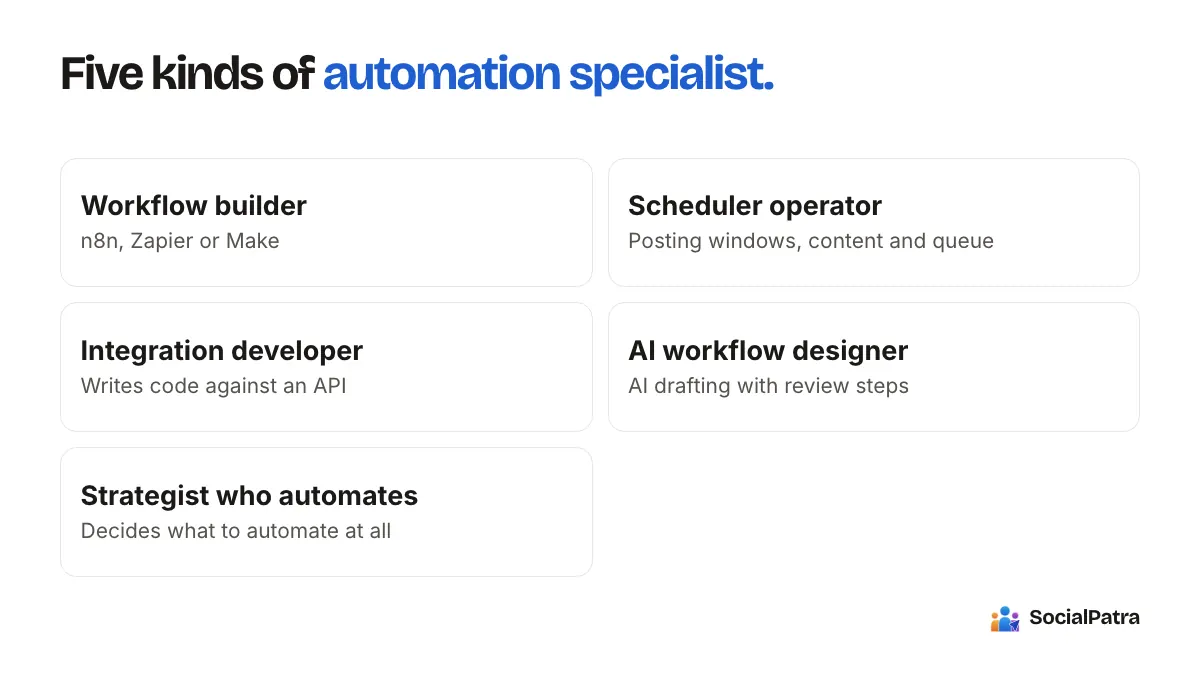
The title covers several different jobs. Know which one you need before you write the brief.
- Workflow builder. Connects your store, forms, or newsletter to your social accounts using tools like n8n, Zapier or Make. Good for event-driven posting. We cover how these tools pair with SocialPatra in using n8n, Zapier or Make with SocialPatra.
- Scheduler operator. Sets up a dedicated scheduling tool, builds your posting windows, loads content, and keeps the queue full.
- Integration developer. Writes code against an API so your own systems can post and pull reports.
- AI workflow designer. Sets up AI-assisted drafting or an assistant that can work with your tools, with review steps built in.
- Strategist who automates. Plans content and decides what should be automated at all. The rarest and most valuable.
A single person can do two of these well. Be suspicious of anyone who claims all five.
Do you need one?
Often not. A specialist is worth considering when:
- You need something custom, such as posts triggered by your store or CRM.
- You manage many accounts and the setup is large enough to be a project.
- You have budget but no time, and a clear idea of what you want.
You probably don't need one when you run one to three accounts and just need a consistent schedule. Setting up a scheduler, connecting accounts, and loading a month of posts takes an afternoon. Our getting started guide and bulk CSV import guide walk through it. If the job is "post regularly," the cheapest specialist is yourself, once.
How to hire a good one
Write a brief before you talk to anyone
A good brief takes 20 minutes and filters out most poor applicants. Include:
- The accounts and platforms involved.
- The outcome you want, in plain words ("every new product gets one post per network within an hour").
- Which tools you already use and which you are open to.
- Who approves content and how.
- Your budget range and timeline.
Ask for evidence
- A walkthrough of a similar project, with what went wrong and how they fixed it.
- Whether they have run something for months, not just built it.
- What they'd do when a social connection expires or a post fails.
You cannot verify every claim, so lean on process answers. Anyone who has run these systems will have stories about failures. Anyone who hasn't will say everything just works.
Ask the questions that expose weak candidates
- "Who owns the accounts and the automation after you finish?" The answer should be you.
- "How will I know if it breaks?" You want alerts or a regular check, not silence.
- "What will you document?" You need a short written handover.
- "What shouldn't we automate?" A good specialist will name things to keep human, such as replies to upset customers. See what to automate vs post manually.
- "Which permissions do you need?" The right answer is the narrowest set.
Protect access from day one
Never share your personal passwords. Use team invitations so the person has their own login and you can remove them later. If code needs to call an API, use a key limited to the exact permissions required, with an expiry date, so you can revoke it without touching anything else. In SocialPatra, API keys are workspace-scoped, carry a chosen list of permissions, and can have an expiry, rate limits, and IP restrictions. See developer API keys. API access is on paid plans.
Start with a paid trial project
Agree a small, defined first deliverable, such as one working flow, before committing to a long engagement. You learn how they work for a small outlay.
What does it cost?
We aren't going to quote market rates; they vary by region, experience, and scope, and any figure we printed would age badly. Here is how to estimate your own.
- One-off setup is usually priced by the project or by hours. Ask for a fixed price against your written brief.
- Ongoing support is usually a small monthly retainer or hourly. Ask what is included.
- Tool costs are separate and continue after the specialist leaves. Count them.
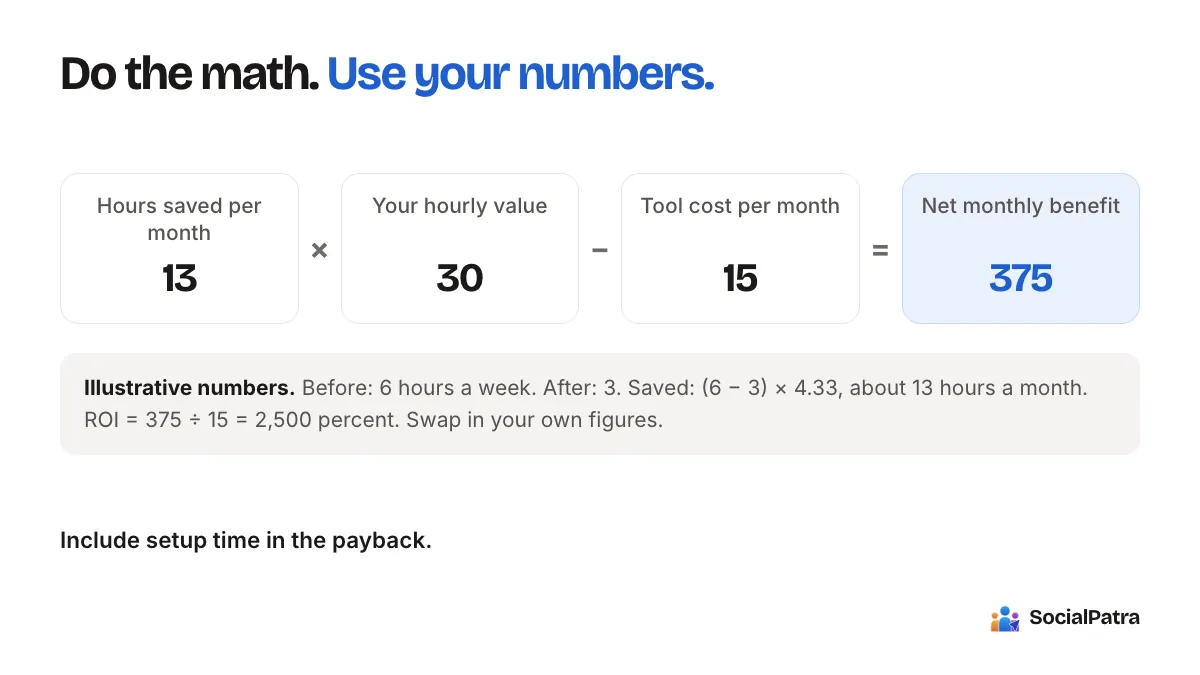
Then compare against doing it yourself using the same method as in our ROI guide: your hourly value times the hours you would spend learning and building, versus the specialist's quote plus the time you spend briefing and reviewing. Include the learning curve honestly. If the job would take you 20 hours and you value your time above the specialist's rate, hiring is rational. If it would take two hours, it is not.
Don't forget the hidden cost of a bad hire: a workflow nobody understands, running on accounts you don't control.
Red flags
- Promises of guaranteed follower growth or sales.
- Asking for your passwords instead of a proper invitation.
- "Fully automated, no review needed" for anything customer-facing.
- No documentation, or no plan for who maintains it.
- Pricing that ignores the tool subscriptions you will pay for.
- Claims about features of a tool that they cannot show you in the tool's own interface.
Working with an agency or specialist in SocialPatra
If you hire help for a scheduler, you can give them their own team seat rather than a shared login. Agencies and freelancers who manage several brands can keep each client in a separate workspace, which keeps content and accounts apart. See agency workspaces. Team members and extra workspaces come with paid plans.
When the best "specialist" is a good setup
Before you spend, try the minimal version. Connect your accounts, load two weeks of content, set time slots, and watch the results for a month. Then decide what is still missing. Many people find the answer is a small custom flow rather than a full build, which makes any hire cheaper and tighter. When you do have a brief, the best practices guide is a useful thing to hand over so everyone starts from the same rules.
FAQ
What does a social media automation specialist do?
They set up and maintain systems that post, schedule, and report for you. That may mean configuring a scheduler, building workflows between your business apps and social accounts, or writing code against an API.
How much does it cost to hire one?
It varies with scope and location. Get a fixed quote against a written brief, ask what ongoing support includes, and add the cost of the tools themselves.
Can I just do it myself?
For a few accounts and regular posting, usually yes, in an afternoon. Hire when you need custom triggers, large-scale setup, or when your time is worth more than the quote.
How do I keep control of my accounts?
Use team invitations or scoped keys, never shared passwords. Keep ownership of the accounts and tools in your name, and ask for written documentation at handover.
Pick a plan and set up the basics yourself before deciding what you need to outsource.
Whether you hire or do it yourself, software for social media managers removes most of the repetitive work.